


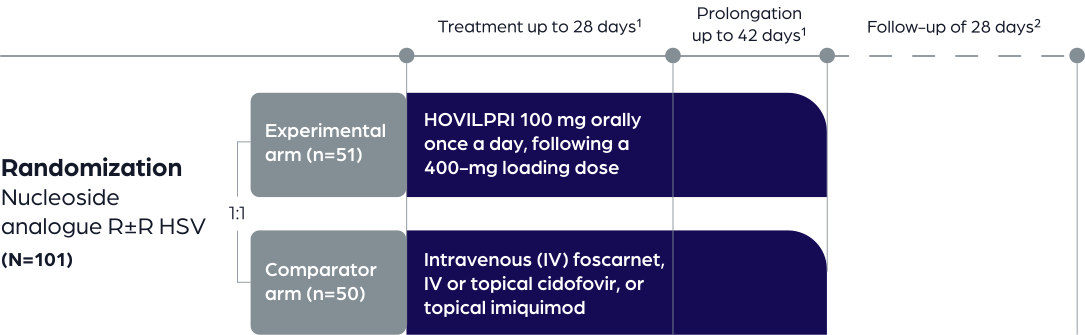
Study design for the PRIOH-1 Phase 3 (Part C) clinical trial that evaluated HOVILPRI®
HOVILPRI (pritelivir) tablets were studied vs investigator’s choice of treatment in a randomized, comparator-controlled, open-label, superiority trial (Part C) in immunocompromised adults with refractory ± resistant (R±R) mucocutaneous herpes simplex virus (HSV) infections.1

Primary efficacy end point
Response rate up to Day 28, as assessed by the investigator as complete healing (complete epithelialization) of all lesions1,*
Key secondary efficacy end points
Response rate up to Day 42, median time (days) to lesion healing, mean rate of individual HSV DNA detection, median time (days) to undetectable HSV DNA, and hospitalization rates1,2,†
*Response rate was defined as all mucocutaneous HSV lesions healed by complete epithelialization within the treatment period and no appearance of new lesions post end of treatment, as assessed by the investigator.1
†Defined as the proportion of patients achieving complete lesion healing during the treatment period up to 42 days.1,2
Eligible patients were immunocompromised adults with nucleoside analogue R±R mucocutaneous HSV infection1,2
Refractory
No clinical improvement in HSV infection after at least 7 days with standard-of-care nucleoside analogue (acyclovir, valacyclovir, or famciclovir) treatment1
Resistant
Local laboratory-confirmed genotypic/phenotypic resistance for the current outbreak1
Patients were excluded if they had known resistance or intolerance to pritelivir or any of the excipients, were previously treated in PRIOH-1, had certain baseline safety laboratory abnormalities, were receiving hemodialysis for any indication and had end-stage renal disease, among other reasons.2
Baseline adult patient characteristics3,4
| Full analysis population‡ | HOVILPRI (n=51) | Investigator’s choice (n=50) |
|---|---|---|
| Mean age, years (SD)3,4 | 49 (14.9) | 56 (14.6) |
| Sex at birth, n (%)3,4 Male Female | 32 (62.7%) 19 (37.3%) | 21 (42.0%) 29 (58.0%) |
| Reason for treatment start, n (%)3,4 Refractory HSV (clinical failure) Laboratory-confirmed acyclovir resistance | 39 (76.5%) 12 (23.5%) | 33 (66.0%) 17 (34.0%) |
| Immunosuppressive condition, n (%)4,§ Transplant (HCT, SOT) Oncology/autoimmune/inflammatory disorders HIV infection | 16 (31.4%) 19 (37.3%) 16 (31.4%) | 28 (56.0%) 15 (30.0%) 7 (14.0%) |
‡Full analysis set includes all patients who received at least 1 dose of the trial medication (N=101).1,2
§A patient is counted under only 1 immunosuppressive condition category, based on the hierarchy of “Transplant,” “Oncology/autoimmune/inflammatory disorders,” and then “HIV infection.”4
See the trial data

HCT, hematopoietic cell transplant; HSV, herpes simplex virus; IV, intravenous; MOA, mechanism of action; R±R, refractory with or without resistance; SOT, solid organ transplant.
References: 1. HOVILPRI. Prescribing information. Asahi Kasei Therapeutics. 2. Data on file. Asahi Kasei Therapeutics. 3. Chemaly RF et al. Presented at: ESCMID Global; April 17-21, 2026; Munich, Germany. 4. Papanicolaou GA et al. Presented at: Transplantation & Cellular Therapy Meetings of ASTCT and CIBMTR; February 4-7, 2026; Salt Lake City, Utah.